Elizabeth McHugh

CUSTOMER SEGMENTATION ANALYSIS

Introduction to Programming for Business (DESN 210)

OVERVIEW

Subtract 1 Streamline Icon: https://streamlinehq.com Add 1 Streamline Icon: https://streamlinehq.com

An analysis of iFood customer data — Brazil’s leading food delivery platform — examining how demographic characteristics influence spending behavior and campaign acceptance rates. Results identify high-value segments to support marketing segmentation strategy.

The iFood Data Classification dataset includes demographic and behavioral data for 2,204 customers, collected over a two-year period. Variables include age, education level, marital status, household income, purchasing behavior across multiple product categories, and acceptance rates across five marketing campaigns. Monetary values are in BRL (R$). Household size and average spending across regular (non-gold) product categories were added as calculated variables; education level and marital status were recoded as categorical variables.

Exploratory analysis and data visualization assessed spending patterns and campaign acceptance across demographic groups. Statistical testing included one-way ANOVA, correlation analysis, and linear regression, each at a significance level of α = 0.05.
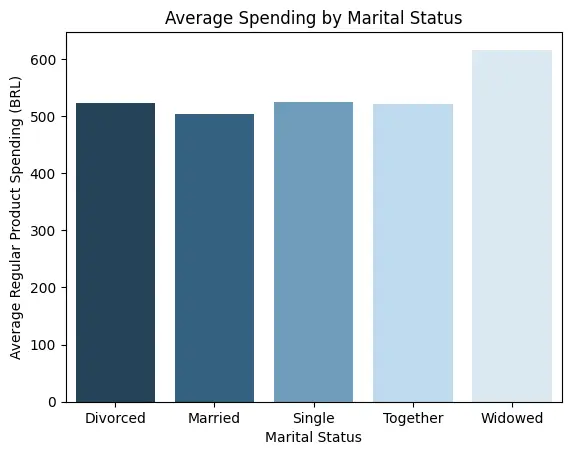
Marital status does not predict spending.

Spending is consistent across marital status groups (p > 0.05). Widowed customers trend slightly higher, but the difference is not statistically significant.

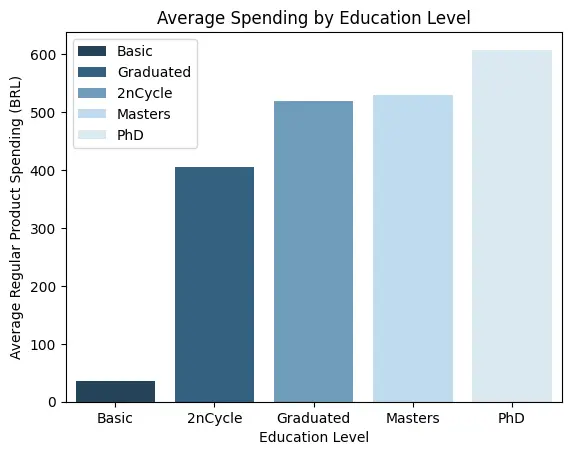
Higher education correlates with higher spend.

Education level significantly influences spending on regular products (p < 0.05). PhDs average 608 R$ — roughly 90 R$ above the sample mean — with a 572 R$ range across all education categories.

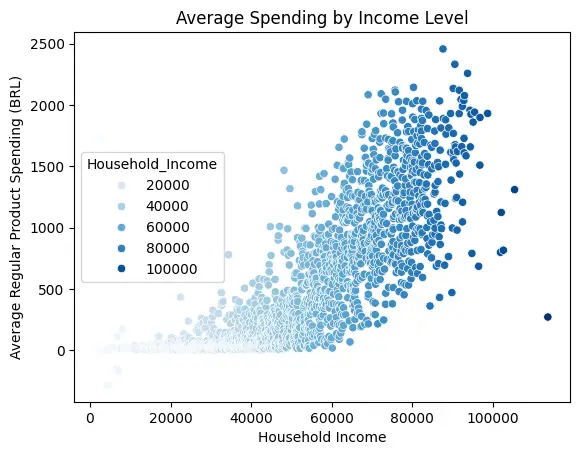
Income is the strongest spending predictor.

Every 1 R$ increase in income corresponds to a 0.03 R$ increase in average spend. Income accounts for ~67% of spending variation (R² ≈ 0.67).

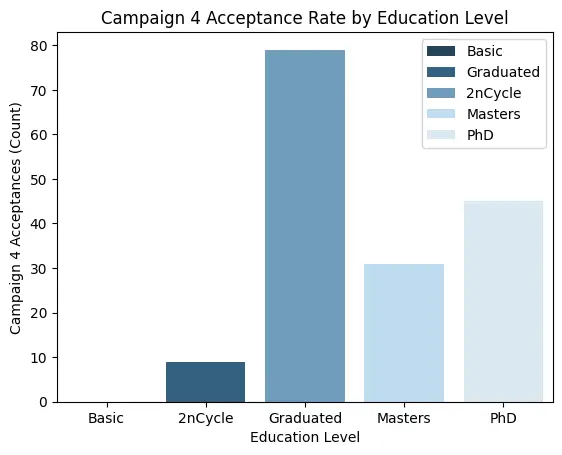
Education drives Campaign 4 acceptance.

Bachelor’s-level customers show notably higher acceptance rates for Campaign 4. No other campaigns show significant demographic differences.

Prioritize high-income and high-education segments.

These groups show the strongest correlation with spending. Target them with value-based promotions and tailored messaging.

Optimize Campaign 4 for bachelor's-level customers.

This segment shows stronger engagement with Campaign 4. Evaluate which campaign elements — messaging, timing, or channel — drive acceptance, then target bachelor’s-level customers with optimized campaigns.

Incorporate behavioral data into future research.

Additional research should incorporate behavioral indicators — purchase recency, website activity, and discount responsiveness — to strengthen segmentation accuracy. Researching campaign-level metadata such as channel, creative format, and timing would also improve interpretation of campaign performance and uncover more actionable findings.